
Let’s talk about anxiety. Often used interchangeably with “stress,” anxiety is actually your body’s response to stress. Where stress is usually triggered by an identified circumstance or threat, the catalyst of anxiety may not be so easily recognizable.

Believe it or not, the main goal of anxiety is to protect you — to alert your body and mind of potential dangers (whether real or imagined) in the form of physiological signals. And the ability to recognize these signals early on can be game-changing when it comes to managing your anxiety.
Fight, flight, freeze: the physical response
When viewed through a biological lens, it’s easy to imagine situations that would trigger your fight, flight, or freeze responses, i.e., predator versus prey. And while that’s a very tangible and historic (and prehistoric) defense mechanism, something that’s surely unique to our modernized society is the role that our minds play in our varying levels of anxiety.
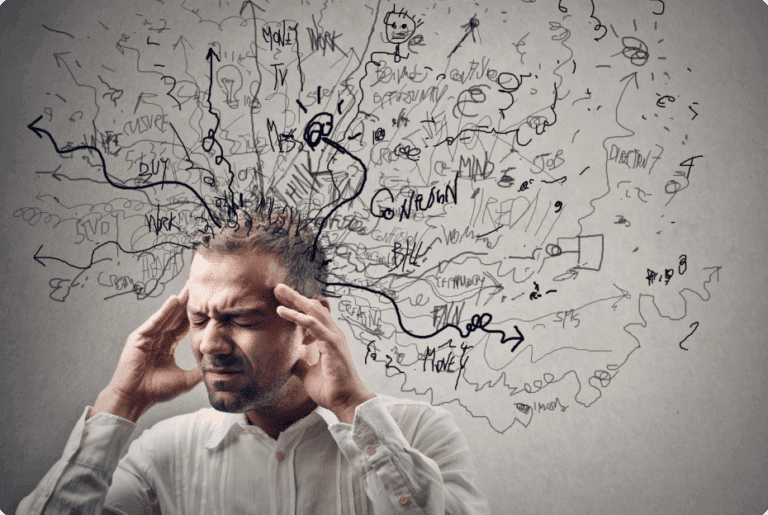
With pure intention (we like to think), our brains love to play protector, even when it’s unnecessary. Sometimes, it’s cycles of endless what-ifs in an attempt to prepare us for every possible scenario. Other times, it pulls us out of the present moment and into a circle of past or potential future events completely out of our control. Not surprisingly, these psychological mechanisms combined with our “fight or flight” stress hormones can commonly materialize outwardly in the form of disrupted sleep patterns.
Thoughts on loop: the psychological response
When viewed through a biological lens, it’s easy to imagine situations that would trigger your fight-or-flight responses, i.e., predator versus prey. And while that’s a very tangible and historic (and prehistoric) defense mechanism, something that’s surely unique to our modernized society is the role that our minds play in our varying levels of anxiety.
With pure intention (we like to think), our brains love to play protector, even when it’s unnecessary. Sometimes, it’s cycles of endless what-ifs in an attempt to prepare us for every possible scenario. Other times, it pulls us out of the present moment and into a circle of past or potential future events completely out of our control. Not surprisingly, these psychological mechanisms combined with our “fight or flight” stress hormones can commonly materialize outwardly in the form of disrupted sleep patterns.
Overthinking and avoidance: the social response
A persistent self-critique is anxiety’s way of trying to secure and perfect your social position. What for many are fleeting moments of replayed interactions and attempts to control others’ views of them, for the anxious mind these can be a slippery slope into rumination, intrusive thoughts, negative thought patterns, and mental spirals. And when these social responses become too strong, the anxious brain might encourage you to avoid social situations altogether.
A new perspective
Though it can feel isolating at times, anxiety is something that connects many of us. Millions of people experience anxiety in some form, and while it may always play a role in your life, it doesn’t have to be a dominant one. By recognizing the common signs of anxiety and learning to effectively manage them, you have the power to regain control of your well-being now and in the future.
Whether you pursue independent coping strategies like breathing and movement techniques, mindfulness practices to ground you, or cognitive methods to help navigate thought patterns — or if you’re seeking support through various groups, communities, or mental health professionals — you are not alone in your experience (and you never have to be).
This content is for informational purposes only and is not a substitute for professional medical advice, diagnosis, or treatment. Always seek the guidance of a licensed healthcare provider with any questions you may have regarding a mental health condition. If you or someone you know is in crisis, call or text 988 (Suicide & Crisis Lifeline) or call 911 for a medical emergency.