
Navigating ADHD and Loneliness: Uncovering the Hidden Challenge

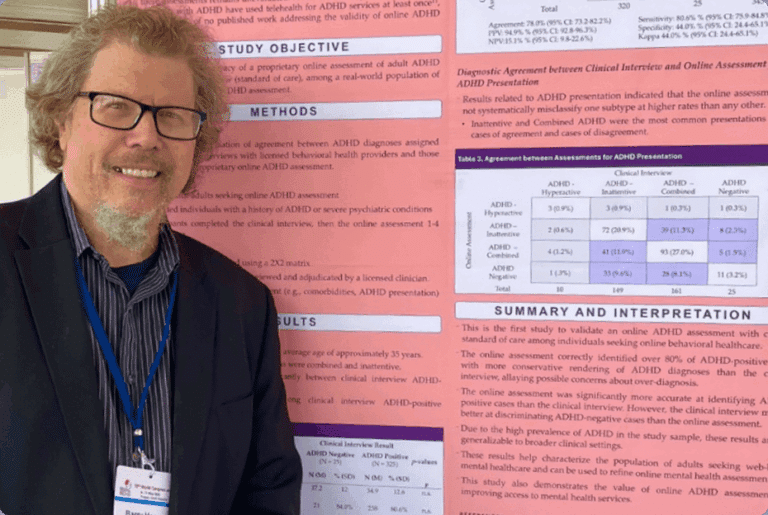
Living with ADHD comes with unique challenges that can affect not only how you manage daily tasks but also how you connect with others. While much focus is placed on the more visible aspects of ADHD, an important but less discussed issue is loneliness. Recent data insights, coupled with the perspective from Dr. Barry Herman, Chief Medical Officer at Mentavi Health, reveal that individuals with ADHD often experience higher levels of loneliness compared to the general population.


white square image
Navigating ADHD and Loneliness image

Understanding the Link

The Surgeon General has identified loneliness as a national crisis, emphasizing its widespread impact on health and well-being. The Surgeon General’s report revealed that 39% of US adults report feeling very connected to others, and approximately half of all adults report experiencing some level of loneliness. This declaration brings to light the critical intersection of loneliness with various health conditions, including ADHD.

Recent aggregate data research by Mentavi Health has uncovered that 35.7% of ADHD patients treated by the company scored moderately high to high levels of loneliness based on the standard UCLA loneliness screener. This is a rate significantly higher than that observed in the general population. This statistic is more than just a number; it signals a deeper issue that warrants attention.

The Impact of Loneliness

For those living with ADHD, loneliness can exacerbate existing challenges, creating a cycle that’s hard to break. Social interactions and maintaining relationships can be more difficult, leading to a sense of isolation. Recognizing the link between ADHD and loneliness is crucial for developing effective interventions and support systems.

Addressing Loneliness: Steps Forward

Recognizing the issue is the first step. Here is the U.S. Surgeon General Dr. Vivek Murthy recommendation for building and strengthening your relationships with a 5-for-5 Connection Challenge:

Step 1: Commit to connect

Pick 5 actions and 5 days in a row to connect with people in your life.

Step 2: Connect each day for 5 days

Each day, take 1 simple action of your choice to express gratitude, offer support, or ask for help. For more ideas, see the card deck below.

Step 3: Reflect and share.

Take a moment. How did connecting make you feel?

Integrating Solutions: The Role of Screening

Mentavi Health has enhanced its ADHD care approach by adopting the UCLA Loneliness Scale in all ADHD assessments, acknowledging the significant link between ADHD and loneliness. This alignment with the Surgeon General’s concerns over loneliness as a national crisis ensures early detection of loneliness, facilitating prompt and precise support.  The insights from this screener are essential to both the patients and the clinicians treating them. Dr. Barry Herman underscores the value of this integration, viewing it as a crucial component of comprehensive healthcare for ADHD patients. 

By prioritizing the identification and management of loneliness, Mentavi Health is advancing ADHD treatment towards a more inclusive, effective model that promises improved quality of life for those affected.


The Expert Mental Health Care You Need Now

From ADHD to anxiety and beyond—we can help.
Start Your Assessment

Learn About ADHD Services in Your State

Live your best life with ADHD

Learn more about the three steps to Medical Treatment for ADHD
3 Simple Steps

More than ADHD?

From anxiety and depression to binge eating and obsessive compulsive disorder, ADHD rarely operates alone. Our Mentavi Diagnostic Evaluation screens for common comorbidities.
Learn More
Share:
Explore More

The constant present: Time blindness and ADHD

Time blindness and ADHD - “Where did the time go?” It’s a question that everyone asks from time

Thriving in college with ADHD

From staying organized and building strong study habits to prioritizing self-care and making the most of accommodations, there’s

Virtual mental health that’s accessible, affordable, and clinically validated

Our first-of-its-kind validation study marks a significant milestone in the evolution of credible, clinical mental health assessment and
Articles

The constant present: Time blindness and ADHD

“Where did the time go?” It’s a question that everyone asks from...
Podcasts

Part Two: ADHD and Time Blindness with Dr. Ari Tuckman

Today, we’re continuing our conversation with Dr. Ari Tuckman, exploring...

Curious about stimulant or non-stimulant approaches?

If you’re navigating ADHD or other mental health challenges, you have options. At Mentavi Health / ADHD Online, we assess what works for you. 
Some may start with non-medicated approaches like coaching or therapy.  In other cases, patients may explore medication treatment paths when warranted by diagnosis. For some diagnosed with ADHD, the treatment clinician may work with the patient to determine if stimulant approaches work best for them. Stimulant approaches are certain medications under medical treatment that are generally Class II controlled substances. Non-stimulant options are another approach that can work for many.  Medication approaches can be used in tandem with coaching or therapy. 
 
The key is starting with our diagnostic evaluation, which is reviewed by a qualified healthcare professional. Getting clarity on what you’re experiencing is the first step toward feeling more in control. From there, you and your treatment team can determine the best path—whether that’s coaching, therapy, medication, or a combination that works for your life. 
 
If you’re not feeling right, let us walk alongside you by starting with the diagnostic evaluation.
There may be a brief delay in service today between 12:30 PM and 1:30 PM ET. Thank you for your patience — we look forward to assisting you shortly.
 
The ADHD Online Team

Join Our ADHD Research Study

Mentavi Health is conducting ADHD research and is accepting a limited number of participants. Participants in our clinical study will get an ADHD Assessment at no cost. 

Who can join?
  • Age 19+
  • Primary language is English
  • Not previously diagnosed with ADHD
  • Not a current patient of ADHD Online or Mentavi Health
  • A resident of any of the 50 US states or DC (not including Puerto Rico or other territories)
 
Why participate?
Your involvement will help improve mental health care for everyone.
 

HOLIDAY HOURS

ADHD Online will be closed on Monday, January 19, in observance of Martin Luther King Jr. Day.

Live support will be unavailable, but you may still submit a request or leave a message. We’ll respond when we return.

Our Diagnostic Evaluation is always available—on your schedule.

Our website remains open 24/7 for scheduling appointments, accessing ADHD resources, and viewing recorded webinars.

Provide this form to your local practitioner. You could:

  • Send this link
  • Email the pdf
  • Print it out and bring it to your appointment

Ask your practitioner
to complete the form

In this form, your practitioner will request that ADHD Online continue to provide uninterrupted care

Return the form to us

You or your practitioner can return this form to us via email or fax it to 616-210-3118